I want to begin with a disclaimer, because the women who live with endometriosis have been failed by enough teachers already and I do not want to be one of them. I am not a doctor. Yoga is not a treatment. If you are in pain, please find a gynaecologist who believes you — they exist, I promise — and please do not let any practice on this page replace medical care.
What I can offer is what I have seen, in close to a decade of teaching, in the bodies of women who have come to me with this diagnosis or its sisters: adenomyosis, fibroids, chronic pelvic pain. None of them have been cured by yoga. Many of them have found a measure of relief. A few have found something more — a way to live inside the body again, even on the days when the body is unkind.
Seven practices, gently
I will list these as briefly as I can, in the order I usually teach them. They are not a programme. Take what is useful. Leave what is not.
One. Constructive rest. Lie on your back. Knees bent, feet flat, hip-width apart. A folded blanket under the lower back if it helps. Stay for ten minutes. Do nothing. Breathe through the nose. This is not a posture; it is a permission slip. Many women cannot do anything else on a flare day. This is enough.
Two. Reclined butterfly (supta baddha konasana). Soles of the feet together, knees falling open, supported by bolsters or pillows so the hips do not have to work. The space between the inner thighs is one of the few places where most women do not consciously hold tension. Resting here often releases something that more active postures cannot reach.
Three. Long exhales. Inhale for four counts. Exhale for eight. Do this for ten cycles. The exhale is what tells the nervous system that the body is safe. Most women in chronic pain have lost the long exhale. It comes back, slowly, with practice.
Four. Castor oil compress. This is not yoga, exactly, but it belongs here. A flannel cloth soaked in warm castor oil, placed on the lower belly, covered with a hot water bottle, for thirty to forty minutes. Twice a week, away from the bleed. Many of my students with endometriosis say this is the single most useful thing I have ever taught them.
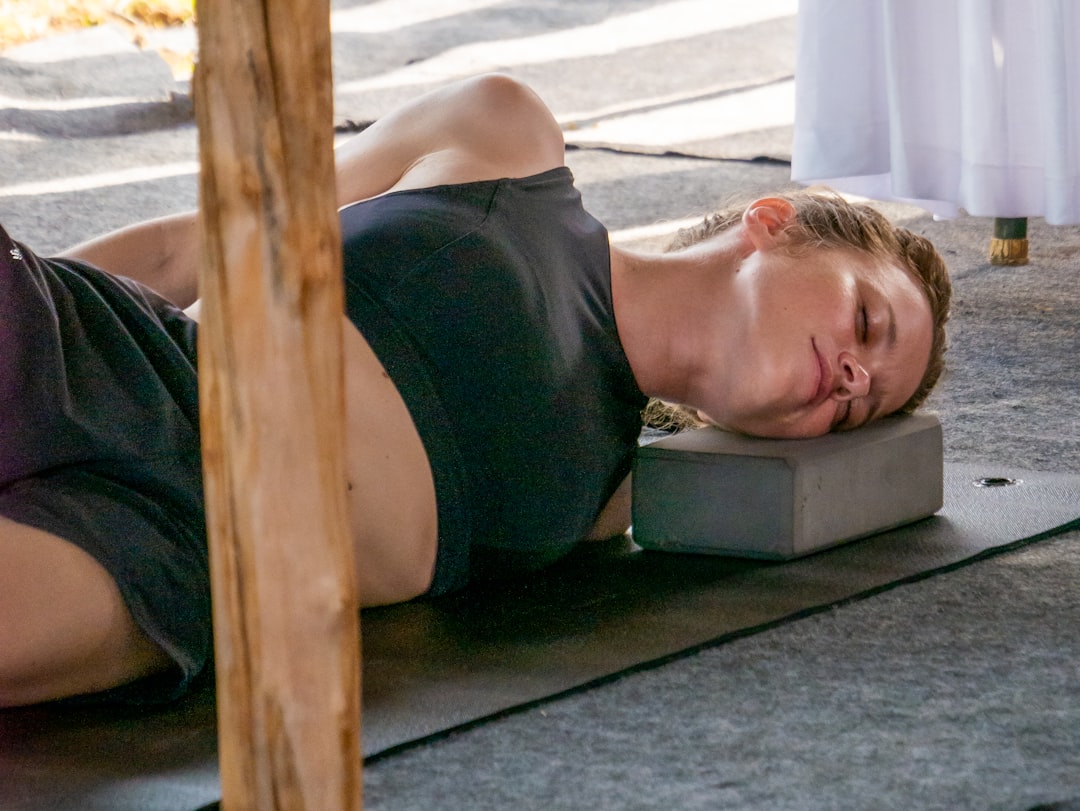
Five. Side-lying child's pose. A folded blanket between the knees, the body curled gently on its side, one arm under the head. Ten breaths on each side. The fetal position is a posture for a reason. The body remembers it.
Six. Soft, slow walking. Twenty minutes a day, somewhere with trees, without a phone. Movement matters, even on the heavy days. But it must be the kind of movement that does not extract anything from the body — only invites it forward.
Seven. The hand on the belly. The same one I write about every month. Both palms, warm, on the lower belly. Three minutes. Once a day. The body has been managing this pain for a long time without thanks. The hand says thank you. The body listens.
The women I have seen find the most relief are not the ones who push hardest. They are the ones who learn to let the body lead.
What I do not believe
I do not believe endometriosis is caused by suppressed emotion. I do not believe it is a punishment, a karmic debt, or a sign that you have not loved your feminine enough. I have heard all of these things said by people who should have known better, and I have watched them deepen the suffering of women who were already suffering plenty.
What I do believe is that the body holds pain in particular places, and that those places — the belly, the pelvis, the hips — respond to slow, kind, deliberate attention. Not always. Not predictably. But often enough that I keep teaching.
The prayer
I do not have a prayer of my own to offer here. I have a translation of one my grandmother used to say, in Tachelhit, when one of the women in her village was in pain. It is short. It is not religious in a way that requires belief. I will share it as she said it, in case it is useful to someone.
May the pain not be the whole of the day.
May the body remember it has been held.
May the night come gently. May tomorrow be smaller.
I say this for the women who write to me. I say it for myself, on the days when I need it. I say it for you, now, if you have read this far.
— Ghizlan